Knowing how to keep score in bowling makes the game more enjoyable and easier to follow. A standard game runs 10 frames. Your final score depends on how many pins you knock down - plus bonus points for strikes and spares.
Bowling scoring is simple once you understand the basics. This guide explains how the scoring system works, what the average bowling score looks like, and what counts as a good bowling score at every skill level.
Bowling Scoring Basics: How It Works
Bowling uses a frame-based scoring system. Each game has 10 frames, and you get up to two rolls per frame to knock down all 10 pins.
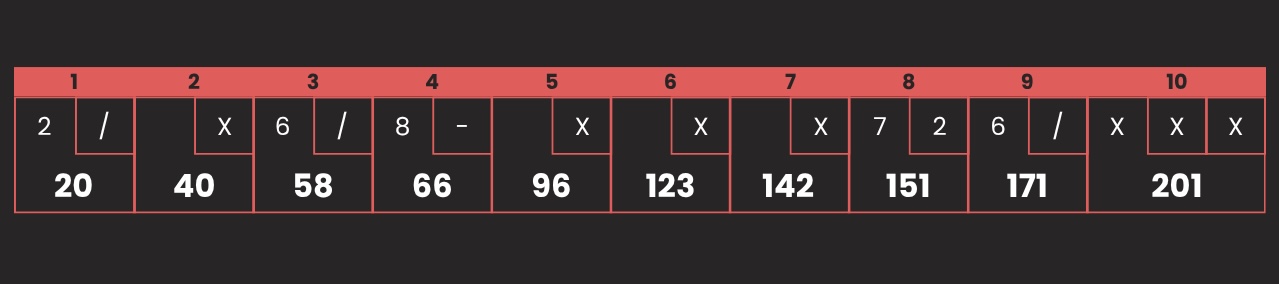
Your score for each frame is the number of pins you knock down. But when you bowl a strike or a spare, you earn bonus points based on your next rolls. That bonus system is what separates bowling scoring from a simple pin count.
Your goal in every frame is to knock down all 10 pins. The more you do it - and the earlier you do it - the higher your score climbs.
How Many Frames Are in a Game of Bowling?
A standard game of ten-pin bowling has 10 frames. In frames 1 through 9, you get up to two rolls to knock down all 10 pins. In the 10th frame, you can earn up to three rolls - but only if you bowl a strike or spare on your first two shots.
If you knock down all 10 pins across two rolls without getting a strike - called an open frame - your score for that frame is simply the total pins knocked down. There are no bonus points for an open frame.
How a Strike Is Scored
A strike happens when you knock down all 10 pins on your first roll in a frame. It is marked on the scoresheet with an X.
A strike scores 10 points plus the total of your next two rolls. That bonus is what makes strikes so valuable - a strong follow-up can turn a single frame into 20 or 30 points.
Here is how a strike scores in practice:
- Frame 1: Strike (X)
- Frame 2: You roll a 7, then a 1
- Frame 1 score: 10 + 7 + 1 = 18
- Frame 2 score: 7 + 1 = 8
- Total after two frames: 26
Three strikes in a row - called a turkey - scores 30 points per frame. That is the highest single-frame score possible in bowling.
Having trouble understanding bowling terms? Check out our bowling dictionary
How a Spare Is Scored
A spare happens when you knock down all 10 pins using both rolls in a frame. It is marked with a / on the scoresheet.
A spare scores 10 points plus your next one roll. It is worth less than a strike, but converting spares consistently is one of the most effective ways to raise your average bowling score.
Here is the same scenario scored as a spare instead:
- Frame 1: Spare (7 + 3)
- Frame 2: You roll a 7, then a 1
- Frame 1 score: 10 + 7 = 17
- Frame 2 score: 7 + 1 = 8
- Total after two frames: 25
The strike scores 26. The spare scores 25. That one-point gap per frame adds up significantly over a full game.
What Is the Average Bowling Score?
The average bowling score for a recreational adult bowler is around 110 to 150. That number reflects casual players - people who bowl occasionally without formal training or league experience.
For registered league bowlers, the average sits closer to 150 to 190. These players bowl regularly and work on their technique over time.
If you are just starting out, scoring anywhere near the recreational average is a solid result. Most beginners start between 70 and 100 and climb steadily with practice.
What Is a Good Bowling Score?
A good bowling score depends on your experience level. What counts as a great score for a beginner is average for a league bowler and low for a professional.
What Is a Good Bowling Score for a Beginner?
For a beginner, a good bowling score is anything around 100 or above. Reaching 100 means you are making consistent contact with pins and starting to convert spares. Breaking 150 is a strong next milestone as your technique develops.
Is 150 a Good Bowling Score?
Yes - 150 is a solid bowling score for a casual player. It puts you above the general recreational average and shows consistent spare conversion. For a beginner, 150 is an excellent target to work toward.
What Is a Good Score for an Experienced Player?
For league bowlers or experienced amateurs, a good score in bowling starts at 180 to 190. Bowlers in this range are hitting strikes regularly and rarely leaving open frames.
What Is a Good Score in Bowling for Professionals?
Elite bowlers average 220 to 240 or higher, depending on lane conditions. On tougher oil patterns, anything above 200 is considered a strong performance. PBA Tour players regularly post averages well above 220 during competition.
What Is a Perfect Score in Bowling?
A perfect bowling score is 300, achieved by rolling 12 consecutive strikes - one in each of the 10 frames, plus the two bonus shots earned in the 10th frame. It is the holy grail for serious bowlers and a rare feat, even for professionals.
| Skill Level | Average Score Range | Good Score Target | Notes |
| Beginner | 70 - 120 | 100+ | Focus on form, consistency, and spare shooting. |
| Casual / Recreational | 110 - 150 | 130 - 150 | Spare conversion moves the needle fastest at this level. |
| League / Experienced | 150 - 190 | 180 - 190+ | Regular league bowlers typically fall in this range. |
| Professional | 210 - 240+ | 220 - 240+ | Score depends on oil pattern difficulty. |
| Perfect Game | 300 | 300 | 12 consecutive strikes. Very rare, even for pros. |
How to Improve Your Bowling Score
The fastest way to raise your bowling score is to convert more spares. Most recreational bowlers leave open frames - frames where they miss a makeable spare. Each missed spare costs you 10 or more points compared to what you could have scored.
Beyond spare shooting, these habits make a consistent difference:
- Work on your approach. A repeatable four or five-step approach leads to more consistent ball placement at the foul line.
- Target the arrows, not the pins. The arrows on the lane are closer to you than the pins. Aiming at them is more accurate and easier to repeat.
- Choose the right bowling ball. Using a ball that fits your hand and matches your style removes unnecessary difficulty.
- Bowl regularly. Consistency comes from repetition. Even one session per week builds muscle memory faster than occasional play.
For a deeper look at technique, visit the Bowler's Academy on BowlingLife.
FAQ: Bowling Scoring Explained
How is a strike scored in bowling?
A strike earns 10 points plus the total of your next two rolls.
How is a spare scored in bowling?
A spare gives you 10 points plus the score of your next one roll.
How many frames are in a bowling game?
There are 10 frames. In the 10th frame, you may get up to 3 shots if you score a strike or spare on your first two rolls.
What is the average bowling score?
The average score for a recreational adult bowler is 110 to 150. For regular league bowlers, the average is closer to 150 to 190.
What is a good bowling score for beginners?
A score of 100 or more is a great start. Many beginners aim to eventually break 150 as their technique improves.
Is 150 a good bowling score?
Yes. A score of 150 is above the recreational average and shows solid spare conversion. For a casual bowler, it is a strong benchmark.
What is considered a decent bowling score?
For most recreational players, anything above 130 is a decent score. Above 150 shows real improvement in spare shooting and pin carry.
What is a good bowling score for professionals?
A consistent average above 200 is strong. Top PBA Tour players average 220 to 240+, depending on lane conditions.
What is a perfect score in bowling?
A perfect score is 300, achieved by bowling 12 consecutive strikes across all 10 frames.
What is an open frame in bowling?
An open frame is any frame where you fail to knock down all 10 pins in two rolls. Open frames score only the pins knocked down - no bonus points apply.
How do I improve my bowling score?
Focus on spare conversion first, then work on a consistent approach, targeting the arrows rather than the pins, and choosing the right bowling ball for your style.